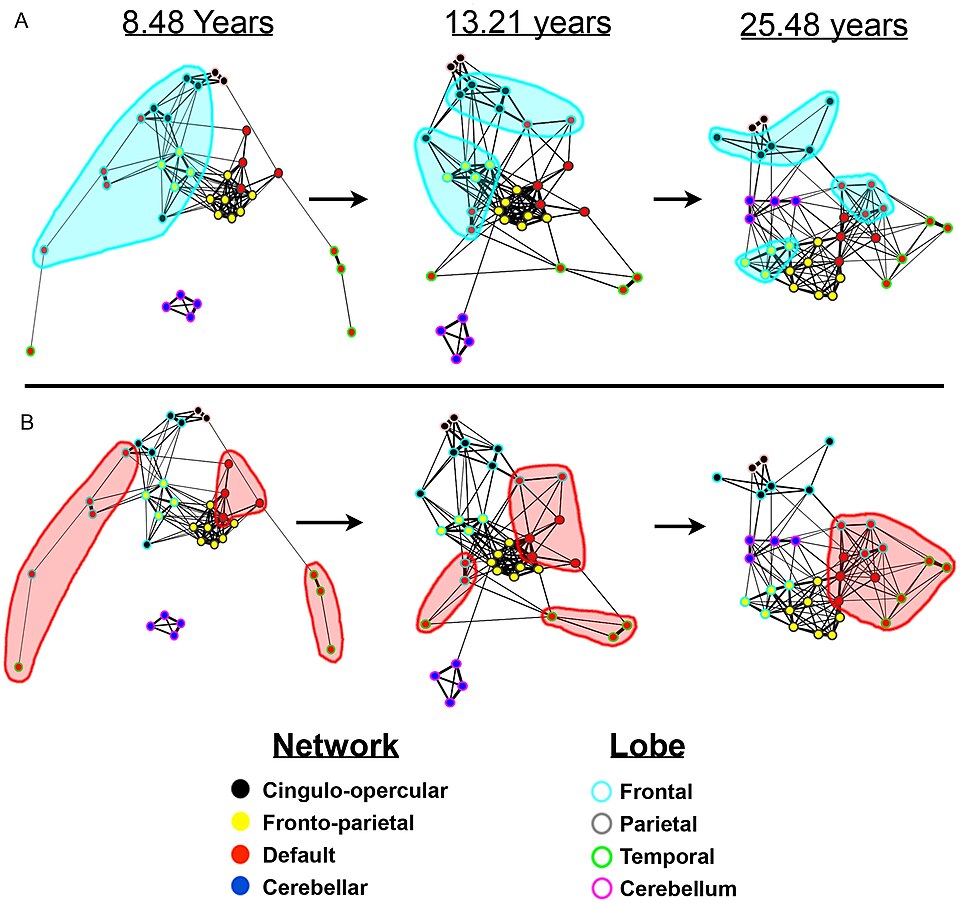
Brain network activity during time perception tasks — Fair et al. (CC BY 2.5)
"Time is not a constant; it's a construct of our brains, shaped by attention, emotion, and expectation."
Neural Mechanisms
Fair, D. A., et al. (2004). "The Development of Human Brain Networks During Childhood." NeuroImage — Maps neural network development affecting temporal processing
Buhusi, C. V., & Meck, W. H. (2005). "What makes us tick? Functional and neural mechanisms of interval timing." Nature Reviews Neuroscience — Comprehensive review of timing mechanisms
Grondin, S. (2010). "Timing and memory of time." Attention, Perception, & Psychophysics — Explores how memory systems interact with temporal perception
Attention and Time
Block, R. A., & Zakay, D. (1997). "Prospective and retrospective duration judgments: A meta-analytic review." Psychonomic Bulletin & Review — How prospective vs retrospective timing differs
Jazat, F., et al. (2004). "Stress-induced delay of circadian clock: An adaptive mechanism in mammals." Neuroscience Letters — Stress effects on temporal processing
Time and Creativity
Taylor, C. W. (1959). "The creative experience: A psychological perspective." — Early foundational work on flow states and time dilation
Csikszentmihalyi, M. (1990).Flow: The Psychology of Optimal Experience — Classic text on how engagement alters time perception
Online Resources
The Time Perception Research Group — Ongoing research into temporal cognition
Flow Research Collective — Community resources for flow state optimization
Chronobiology Society — Circadian rhythm and time biology research
"The experience of time flowing differently is not a bug of consciousness—it's a feature that allows us to adapt to our needs."